Tuesday, 5 October 2010

Alison Rossiter | Yossi Milo, New York

Fuji, exact expiration date unknown, ca.1930's, processed in 2010
Gelatin Silver Print, Diptyc
Fuji, exact expiration date unknown, ca.1930's, processed in 2010
Gelatin Silver Print, Diptyc
Eastman Kodak Royal Bromide, expired March 1919. processed in 2010
Gelatin Silver Print
Barnet Bar-Gas, Exact expiration date unknown, ca. 1925 processed in 2007
Fingerprint found fr, Gelatin Silver Print, Smaller than 2 1/2 x 3 1/2 inches
 Ansco Cyko, Expires Dec 1, 1917, processed in 2007
Gelatin Silver Print, 6 x 4 inches


Alison Rossiter | Reduction
September 23rd - October 30th 2010
Alison Rossiter’s photographs are created without a camera on expired, vintage photo paper. The artist experiments with gelatin silver papers she collects from throughout the 20th century, making controlled marks by pouring or pooling photographic developer directly onto the surface of the paper. Dark forms emerge which often resemble mountainous landscapes or active tornados; other shapes are paired by the artist to create minimalist diptychs.
Each batch of gelatin silver paper, such as Eastman Royal Bromide, which expired in 1919, or Nepera- Velox, which expired in 1906, possesses unique qualities, depending on its particular color, surface, condition and age. Utilizing her experience in conserving photographs, Ms. Rossiter reacts to these variables and manipulates the interaction of paper and developer by hand, paying tribute to the intrinsic qualities of photographic materials and reintroducing unpredictability into a process which is now commonly digitized.

http://www.alisonrossiter.com

Tuesday, 17 August 2010

Taryn Simon | TED

The Death of a Building | Christoph Gielen


Urban Scotland, 2003

Christoph Gielen in the New York Times

Most of my work as a photographer centers on urban development in the sense of construction and expansion. But not all development succeeds, and not all construction lasts. In recent years a number of cities in Britain have recognized that some of the large public housing projects built during the postwar era have been failures; what were supposed to be new residential communities have been overtaken by crime and drug use. In several cases, particularly unmanageable buildings have even been torn down.

New York, N.Y. (1986) | Raymond Depardon

Monday, 2 August 2010

Incognito | Yancey Richardson

 
 Mitch Epstein, "Untitled, NY, 1996"
24" x 30" Chromogenic Print, Edition of 15

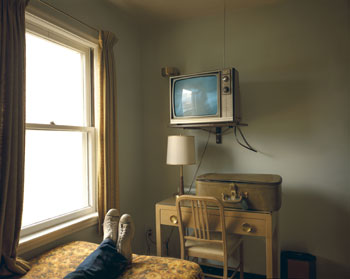
Stephen Shore, "Room 125, Westbank Motel, Idaho Falls, Idaho, July 18, 1973"
20" x 24" C-print, Edition of 8

Matthew Pillsbury, "Matthew Pillsbury, Alias, 9-10 pm, 2010"
13" x 19" Pigment ink print, Edition of 20

 Francesca Woodman, "P.059 Untitled, Providence, Rhode Island, 1976"
(printed 2002-04), 8" x 10" Gelatin Silver Print, Edition of 40

 Ray Metzker, "Philadelphia, 1964"
8" x 10" Gelatin silver print, Edition of 20

 Lisa Kereszi, "Thrilling, Neon Sign, Niagara Falls, Canada, 2005"
30" x 40" Chromogenic Print, Edition of 5
 
 Gail Albert Halaban, "Out My Window, Chelsea, Flower Block from the series 
Out My Window, NYC, 2009", 20" x 24" Archival Pigment Print, Edition of 10


“Incognito,” the current show at Yancey Richardson, explores the ways that photographers can weave their own presence into their work. Many of the photos serve as clandestine self-portraits: traces of the artists appear as shadows, reflections, and body parts, clues embedded within each photographer’s game of hide-and-seek with the camera.

from Photo Booth

Saturday, 31 July 2010

Corinne Vionnet

  from the series Du Glacier du Rône au Lac Léman / From Rhone Glacier to Lake Geneva

Saturday, 17 July 2010

William Kentridge: Five Themes | Jeu de Paume, Paris

 Dessin pour "II Sole 24 Ore [World Walking]"
[Le Soleil 24 heures (Le Monde en marche)]" 2007, William Kentridge
Fusain, gouache, pastel et crayon de couleur sur papier, 213.5 x 150 cm


Journey to the Moon, 2003
35mm and 16mm film transferred to video (black and white, sound) 7:10 min

 William Kentridge, Five Themes
29 June 2010 until 05 September 2010

Featuring about 40 works in a range of media, including animated films, drawings, prints, theater models, sculptures, and books, "William Kentridge: Five Themes" brings viewers up to date on the artist’s work over the past decade, exploring how his subject matter has evolved from the specific context of South Africa to more universal stories. In recent years, Kentridge has dramatically expanded both the scope of his projects (such as recent full-scale opera productions) and their thematic concerns, which now include his own studio practice, colonialism in Namibia and Ethiopia, and the cultural history of postrevolutionary Russia. His newer work is based on an intensive exploration of themes connected to his own life experience, as well as the political and social issues that most concern him.

South African artist William Kentridge (born 1955) first achieved international recognition in the 1990s with a series of what he called “drawings for projection”: short animated films based on everyday life under apartheid. Since then, Kentridge has widened his thematic range, expanding beyond his immediate environment to examine other political conflicts. His oeuvre charts a universal history of war and revolution, evoking the complexities and tensions of postcolonial memory and imaging the residual traces of devastating policies and regimes.

Saturday, 26 June 2010

Unfruchtbare Landschaften | Yvon Lambert, Paris

Unfruchtbare Landschaften, 1969 
Black-and -white photographs, surgical instruments and graphite on bound cardboard
36 x 25 x 4.5 cm, 14 pages

Exhibition View

Anselm Kiefer | Unfruchtbare Landschaften
Yvon Lambert, Paris 19 May –26 June 2010

“Among the works to be exhibited at Galerie Yvon Lambert are a number that were conceived in around 1969, when the artist was 24 years old, including “For Genet,” “The Flooding of Heidelberg” and “Heroic Symbols.” These pieces take the form of strange books on cardboard in which he stuck photographs, watercolours and dried flowers. Even in these early years Kiefer had begun to write down names from his strange, obsessive pantheon. Here, for example, Genet’s name appears with those of Wagner, Beuys and Joan of Arc. These enigmatic clues seem to have been scattered among clichés that are both provocative and disturbing. It is well worth deciphering them and placing them in the context of Kiefer’s art generally, with all its extremes and gigantic scale.

Today, it is indeed important to return to these books which recall some of Kiefer’s very daring interventions. They constitute views or visions, images heavily freighted with memories and symbols, but submerged in blackness, and also self-portraits of the young artist incongruously dressed in a nightshirt or woollen robe, or making the Nazi salute in grandiose or ridiculous settings. At the time, he had taken on the solitary task of what he called the “occupation” of significant spaces – a dark, gratingly ironic gesture that, like the clichés themselves, provoked a scandal. The works were misunderstood, or met with shocked incomprehension, even in the most radical artistic milieus: critics at the time simply could not accept Kiefer’s pathetic and provocative questioning.

Saturday, 15 May 2010

Cyril Croucher | Coverack

Cyril Croucher (b.1951), Coverack, Acrylic

Noriwaki Miyamoto | Dream of Blue Houses

Noriwaki Miyamoto (1940), Dream of Blue Houses, Japanese colour etching with aquatint.

Tuesday, 27 April 2010